What Happens When a Store Makes You Look for It?
At Departamento and Bodega, finding the entrance becomes part of the experience. The question is what happens after the reveal.
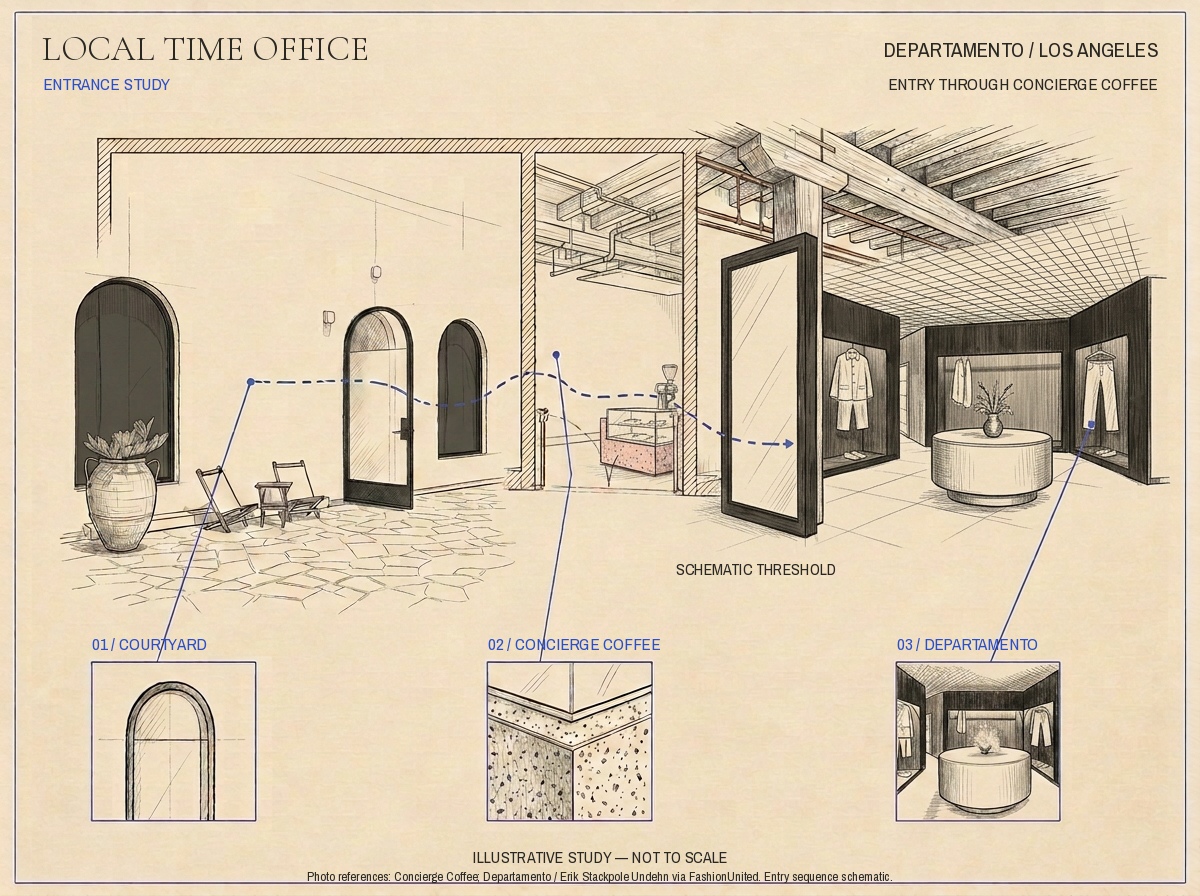
Before you encounter the clothes, you encounter a question: am I in the right place?
A coffee counter might seem an unlikely beginning for a shopping trip. Yet Departamento directs visitors to its Traction Avenue store through Concierge Coffee. Its other location, DPTO Annex on Santa Fe Avenue, is entered through Maru. The instructions are published plainly on the retailer’s website. The stores are discoverable; the route into them is simply unconventional.
At ROW DTLA, Bodega also makes an unexpected entrance part of its identity. The development’s directory describes a concealed entry leading to a streetwear and sneaker store with space for a rotating art gallery. Bodega’s own longstanding description of itself—“Hidden in plain sight”—makes the threshold part of the brand’s language.
These examples raise a question larger than where to find the door. What does a store gain when arriving requires a little attention?
An entrance can establish expectations before a shopper touches a garment. It can turn an errand into an encounter. It can also make someone hesitate, leave, or conclude that the place was intended for somebody else.
The distinction matters. A store that rewards curiosity still needs to welcome the curious.
The entrance sets the terms
A conventional storefront helps people make a quick decision. A name, a window, and a view of the merchandise explain what is available inside.
An indirect entrance changes that sequence. The visitor encounters one space before another. At Departamento and its Annex, coffee precedes clothing. That arrangement introduces the possibility of a different pace: shopping can sit within a longer outing, alongside another reason to be there.
It would take conversations with customers and the operators to establish how often that happens. Someone might discover the shop while buying coffee. Another might arrive specifically for the clothing and pass through without stopping. The architecture allows both; it does not tell us which experience is typical.
What it does make visible is a relationship between activities usually presented as separate destinations. The café becomes part of the approach to the store. The transition gives the visit a beginning.
Discovery is easy to tell someone about
An unusual entrance also provides a small story.
A recommendation can include more than the name of the shop or the designers it carries. It can explain how to find it. The directions themselves become something one person passes to another.
That may give a visit an additional layer of anticipation. Before arriving, the shopper has been told to expect a transition, a reveal, or a room that is not immediately apparent from outside.
There is an important limit to that interpretation. A memorable entrance is not evidence of stronger sales, loyalty, or word of mouth. Those outcomes require their own reporting. But the entrance does offer a distinctive detail through which a place can be described and remembered.
For retailers competing for attention, that is a useful distinction: the design of arrival can contribute to the story people tell about the experience.
The room has to justify the search
The reveal is brief. Shopping continues after it.
An unexpected entrance can make a visitor curious, but the assortment, staff, service, and atmosphere have to sustain that curiosity. Departamento’s online selection spans multiple designers; Bodega’s ROW listing brings clothing, sneakers, and an art-gallery component into the same store. Both offer subjects for discovery beyond the door.
Whether those elements work together is a question for a visit. Does the selection introduce something unfamiliar? Can a shopper ask an elementary question comfortably? Does the space reward browsing without requiring a purchase?
Those details determine whether discovery feels generous.
A store can make someone feel pleased to have found it. It can also make them feel that they should already know how everything works. The difference may have less to do with the entrance than with the welcome on the other side.
A secret can still offer clear directions
Departamento’s published entry instructions suggest an interesting balance. The physical approach can remain unexpected while practical information stays available.
For operators considering a similar format, that balance deserves attention. Clear directions, accurate hours, accessibility information, and an understandable welcome help people decide whether and how to visit. Mystery inside the experience need not require uncertainty about basic access.
Different visitors will encounter the same entrance differently. What feels playful to one person may feel confusing to another. A compelling design should be considered from both perspectives.
The useful question is therefore more specific than whether a shop should be hidden: where does a little uncertainty enrich the visit, and where does it become an obstacle?
What operators should examine
Departamento and Bodega offer examples of arrival becoming part of retail identity. They do not establish a universal formula for successful retail.
The practical lesson is to examine the whole sequence: how someone hears about the place, how they find it, what welcomes them, what they discover inside, and what might bring them back.
For a retailer, the questions are concrete. How many visitors came intentionally? How many discovered the shop through an adjoining business? Where do people hesitate? What do returning customers value once the surprise is familiar?
The answers could distinguish a memorable first visit from a durable relationship.
An entrance can give people a story to tell. The work of the store is to give them something worth returning for.
Sources and method
- Departamento — locations and entry directions — Departamento
- ROW DTLA directory — Bodega — ROW DTLA
- Bodega — Bodega